Germany

country taxonomy block

The event is planned as a marketplace that will enable knowledge transfer between technology experts, service providers and manufacturers as well as users from selected application fields. The goal is to stimulate the development and marketing of new “Copernicus”-related products, services and solutions. The event will build on findings and experience from the German technology network “CopServ” and aims to transfer valuable technological know-how to European level in the framework of the EEN.

Application fields at the focus of the event will be renewable energies/energy economy, maritime technologies, mining/post-mining, agriculture/forestry and urban monitoring/smart cities. The event addresses specialists and executives as well as development engineers from the application fields and defined technology branches along the entire value chain.
Request registration

The 2024 EUMETSAT Meteorological Satellite Conference will take place in Würzburg, Germany, from September 30 to October 4. The theme of this year’s annual EUMETSAT conference is “The Earth Observation value chains for weather, climate, and hydrosphere”.

EUMETSAT will be joined in the organization and hosting of the event by the Deutsche Wetterdienst (DWD), the national provider for weather and climate services in Germany. This key annual event for the meteorological and scientific communities brings together participants from around the world to share their experiences and knowledge during plenary, poster, and workshop sessions.

Registration will be open at the end of May 2024.


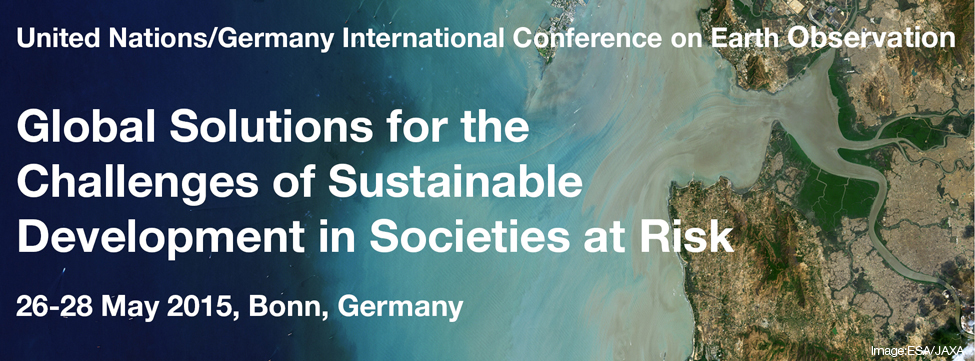
2015 will be a decisive year for the international community paving the way for sustainable development worldwide. Three important processes led by the United Nations are underway leading to three agreements expected for 2015: the Post 2015 Framework on Disaster Risk Reduction (March 2015), the Sustainable Development Goals (September 2015), and the new Climate Change Agreement (December 2015). Geoinformation and especially Earth Observation provide indispensable data to support informed decision making at local, national, regional and global level to reduce disaster risks, improve adaptation to climate change, prepare better for unavoidable losses and damages, and deliver on the promise of sustainable development.

The United Nations/Germany International Conference on Earth Observation – Global solutions for the challenges of...

more

The United Nations Office for Outer Space Affairs (UNOOSA), through its Platform for Space-based Information for Disaster Management and Emergency Response (UN-SPIDER), conducted an International Expert Meeting on 12 November at the UN Campus in Bonn, Germany. “Towards Big (Space) Data in Support of Disaster Risk Reduction and Emergency Response in Africa” aimed at contributing to an increased use of big data approaches and satellite technologies in African countries to respond to challenges posed by natural hazards. It brought together around 45 experts from space agencies, civil protection authorities, development cooperation actors, international organizations, technical relief and humanitarian aid providers, national ministries and the private sector.

The meeting was organized together with the German Aerospace Center (DLR) and in cooperation with the German Federal Ministry for Economic Affairs and Energy (BMWi). The Center for Remote Sensing of Land Surfaces (...

more
Regional Support Offices mentioned:

The EnviroInfo 2021, titled "Environmental Informatics – A bogeyman or saviour to achieve the UN Sustainable Development Goals?", is the 35th edition of the long standing and established international and interdisciplinary conference series on leading environmental information and communication technologies. The conference is open for contributions covering innovative topics at the interface between informatics and environmental research. 

The conference will be organised in thematic sessions and special tracks. The event is taking place at the historic centre of Berlin at the School of Business and Economics, Humboldt-University, in parallel to the annual convention of the German Informatics Society ("Gesellschaft für Informatik") under the umbrella topic “Computer Science and Sustainability”. 

The conference is organized by the Technical Committee for Environmental...

more

The 36th International Symposium on Remote Sensing of Environment (ISRSE), will take place on May 11-15, 2015 in Berlin, Germany. This 36th Symposium will represent a major event in the long series of internationally recognised ISRSE meetings.

The overall theme of the symposium is the use of Earth observation systems and related remote sensing techniques for understanding and managing the Earth environment and resources.

ISRSE-36 takes place at a significant moment: The process to define the UN global development agenda post 2015 with its Sustainability Development Goals will be finalised in 2015. The Future Earth initiative has been created as a global platform to deliver solution-orientated research for sustainability. Among its key challenges are innovative approaches to integrate knowledge systems (data, observation, modelling, etc.), including remote sensing of the environment.

In November 2000, several space agencies joined forces to establish the International Charter "Space and Major Disasters". The International Charter has been set up as a worldwide collaboration through which products generated from satellite imagery are made available free of charge to those responding to disasters in any region of the world. By combining Earth observation assets from different space agencies, the Charter allows resources and expertise to be coordinated. Since it was launched, the Charter has been activated more than 800 times to contribute to disaster response efforts.

During activations, the members of the International Charter provide access to satellite imagery that is processed by Project Managers and Value-Added Providers (PMs & VAs) to generate useful and timely space-based information to be used in disaster response efforts. In the year 2022, the Charter introduced a new tool: the ESA Charter Mapper, to support PMs & VAs in the processing of...

more

This international interdisciplinary CODATA workshop on Risk Information Management, Risk Models, and Applications will enable sharing of best practices as well as giving space for discussing methodological problems in risk modeling from the information systems point of view for all phases of the disaster cycle.

The following areas will be of central interest for the workshop:

risk information management, risk information models; risk databases, risk information interoperability,standards development; risk information processes modelling and applications, services and service composition; natural,technical, chemical risks from local to international level; risk information system structure, components; risk-related databases; risk and multi-risk cartographic issues; risk and risk-model change in time and space; risk modeling issues for infrastructure (e.g. factories, railways, highways, pipelines, maritime traffic etc.); disaster management and emergency preparedness,...

more

The Conference on Big Data from Space will be held on 19-21 February 2019. Big Data from Space refers to the massive spatio-temporal Earth and space observation data collected by a variety of sensors - ranging from ground based to space-borne - and the synergetic use of data coming from other sources and communities. These developments are empowering new approaches and applications in various and diverse domains influencing life on Earth and societal aspects, from sensing cities, monitoring human settlements and urban areas to climate change and security. 

The main objectives of the BiDS’19 Conference are:

  • Focus on new paradigms of data intelligence addressing the entire value chain: data processing to extract information, the information analysis to gather knowledge, and knowledge transformation in value;
  • Maximise the uptake and impact of multi-source space data;
  • Promote the use of platforms and analytical methods to maximise the value...
more

The Applied Geoinformatics for Society and Environment (AGSE) Conference takes place on a yearly basis and is held in different places all over the world. The overall scope of this conferences is to offer an interdisciplinary, international forum for sharing knowledge about the science and application of geoinformatics with focus on developing countries.

Besides invited keynotes the conference invites presentations on a variety of topics. There will also be professional training and workshops about current topics in the fields of geoinformatics and photogrammetry.

AGSE 2019 will take place from 12 to 15 September 2019 at the Stuttgart University of Applied Sciences, Stuttgart, Germany. The title of the event is: “Digital Landscapes: Chances for Development”.

The conference is organized by the Stuttgart University of Applied Sciences, Stuttgart, Germany, and co-organized by the Laboratory for interoperable, and open-source Geospatial Software, Data and Standards (...

more

The UN-SPIDER/ GloFAS / DLR / ZFL International Workshop: “Space technologies for flood management” aimed at contributing to an increased use of satellite technologies and novel processing techniques to respond to challenges posed by disasters. The International Training Workshop aimed:

  • To raise awareness regarding novel techniques and tools developed by DLR, the Copernicus programme, and UN-SPIDER useful in flood management.
  • Contribute to increase the skills of young professionals engaged in the use of Earth observation and novel geospatial information technologies to contribute to flood management efforts.
  • Facilitate networking efforts among young professionals engaged in disaster management efforts.

The International Training Workshop included plenary presentations, a training on the use of novel techniques to process satellite imagery in case of floods, and a simulation of floods to familiarize participants with novel procedures...

more

Satellite observations are a key element in an integrated and sustained climate observing system and have been critically important for monitoring and understanding the Earth’s climate system during the past several decades. The expected completion of the IPCC Fifth Assessment (AR5) in 2013-2014 makes it timely to discuss these achievements, to assess future opportunities and challenges with satellite derived climate information, and to provide guidance on future priorities.

The symposium will be an important step towards defining requirements, and the further development of an efficient and sustained international space-based Earth observing system. This symposium is intended to bring together the international experts in climate observations, research, analysis and modelling to present and discuss results from their studies, with a particular emphasis on the role of space-based Earth observations in improving our knowledge of the current climate at global and regional...

more

Note: Deadline for abstract submission has been extended. New deadline is 15th February 2016.

You can submit your abstract here: http://www.earsel.org/symposia/2016-symposium-Bonn/papers.php. If ou would like to be considered for the session organized by UN-SPIDER, make sure to check "Disaster management" as the applicaion field in your submission. The session will focus on Earth observation applications for the Sendai Framework for Disaster Risk Reduction 2015-2030.


EARSeL is a scientific network of European remote sensing laboratories, coming from both academia and the commercial/industrial sector, which covers all fields of geoinformation and earth observation through remote sensing. All scientists, professionals and researchers involved or interested in the field of the symposium are strongly encouraged to present papers according to the...

more

Registration

Click here to register for the WSF 2024

  • The deadline to apply for funding closes 01.09.2024
  • The call for poster abstracts closes  01.09.2024
  • Deadline for registration to attend in person with visa support request but without funding closes: 03.11.2024

Background

As the planet faces increasing environmental and societal challenges, it requires effective legal frameworks, strong partnerships and global cooperation in order to achieve the goal of sustainable development.

Space science and technology bring an abundance of unique and fundamental benefits to humanity. With growing technological innovation, space exploration serves as a key provider of applications for life on Earth. Space tools enable and drive sustainable development by providing...

more

Global Partnership on Space Technology Applications for Disaster Risk Reduction (GP STAR) is a global partnership that was launched at the third World Conference on Disaster Risk Reduction in Sendai in 2015. It is committed to fostering better and more integrated use of space-based technologies in disaster risk reduction efforts around the world. The partnership conducted its first meeting in Bonn, Germany from 25 to 28 May 2015.

The International Expert Meeting in December 2016 built upon the efforts carried out to contribute to the implementation of the Sendai framework. It provided decision-makers from the disaster management community with guidance on the use of space technology applications in combination with local, in-situ data for better disaster-risk visualisation. The meeting also promoted the use of Earth Observation to track and identify ways to manage climate-related extreme events, e.g. floods, storms or droughts. Lastly,...

more

Climate observations are of fundamental importance for reconstructing, monitoring, understanding, attributing, predicting, projecting, mitigating, and adapting to climate change. They are instrumental for assessments and policy implementations, such as the IPCC and the 2015 Paris Agreement. The need for systematic climate observations is increasing with the growing urgency for adaptation and mitigation measures that can require high resolution information. It is therefore crucial to make further progress towards achieving a fully implemented and sustainable global observing system for climate applications.

The second GCOS Climate Observation Conference (17-19 October 2022, Darmstadt, Germany) will focus on activities and solutions that help to achieve a fully implemented, sustainable, and fit for purpose global observing system for climate. The Conference will also provide the occasion to celebrate GCOS 30th Anniversary and take stock of the progress achieved by the global...

more

Participating Organizations: Bonn International Centre for Conversion (BICC), DigitalGlobe (DG), DG/Tomnod (via webconference), DIFD (via webconference) (UK), DLR (Germany), EC‐GROW Copernicus, EC‐JRC (via webconference), Humanitarian OpenStreetMap Team (HOT/OSM), ImageCat, ITHACA (Italy), NDRCC (China), Pacific Disaster Center (PDC) (US), University of Bonn, UNOOSA/ UN-SPIDER, USGS (via webconference) (US)


Meeting Summary

The 2015 spring meeting was the second IWG-SEM meeting, which was organized as a combination of a physical and web-based conference. 23 participants joined the meeting in person or via web-video-conference.

The agenda included a review and lessons learned of the Nepal earthquake, collaborative mapping, the issuing of the IWG-SEM Emergency Mapping Guidelines 2.0 and the earthquake chapter, and the IWG-SEM GeoRSS.

The detailed meeting outcomes as well as the slides of the presentations are available...

more

Introduction

The international science community is invited to participate in the EarthCARE Science and Validation Workshop, which is jointly organized by the German Aerospace Center (DLR), the German EarthCARE Project Office at the Max Planck Institute for Meteorology (MPI-M) and the European Space Agency (ESA), in cooperation with our partners, the Japan Aerospace Exploration Agency (JAXA) and the National Institute of Information and Communication Technology (NICT).

The EarthCARE Mission

The Earth Cloud, Aerosol and Radiation Explorer (EarthCARE) will provide three-dimensional profiles of clouds and aerosols collocated with observations of reflected solar and emitted thermal radiation in order to quantify the impact of clouds and aerosols on radiation. The mission is being implemented, in cooperation with JAXA and NICT, as the sixth ESA Earth Explorer Mission, with a target...

more

The Regional Support Offices Meeting 2024 was conducted and organised by UN-SPIDER at the premises of the UN Campus in Bonn. It was held back-to-back with the UN-SPIDER Bonn International Conference on Space-based Solutions for Disaster Management - "Early Warnings for All".

The UN-SPIDER programme currently has 27 Regional Support Offices (RSOs). These RSOs are engaged in supporting activities of UN-SPIDER such as technical advisory support, rapid mapping during emergency response, preparing specific publications and contents for the knowledge portal and contributing to the workshop and conferences.

Every year, UN-SPIDER organizes a meeting with the RSOs to discuss the progress and new activities.
At this year’s meeting, 13 RSOs joined the meeting in...

more

"United Nations International UN-SPIDER Workshop: Space-based Information and Solutions for Disaster Management and Emergency Response" For more information visit: http://www.unoosa.org/oosa/en/unspider/index.html

more

"Taking the pulse of our planet from space"

Held every three years, the Living Planet Symposium brings together scientists and researchers from all over the world to present and discuss the latest findings on Earth sciences and advances in Earth observation technologies.

Objectives:

  • Understand Earth Systems: Prove how satellite data and open science contribute to our understanding of the different Earth systems, climate and their interactions.
  • Advance future technology for Earth Observation missions: Demonstrate new Earth observation instruments and technologies for existing and future missions.
  • Nurture public & private sector partnerhips: Highlight the importance of existing and new partnerships, expand the Earth observation user base, increase access to capital and commercialisation.
  • Enable the Earth Observation digital transformation: Demonstrate how next generation technologies will create new...
more

Link to registration: https://indico.un.org/event/1007916/

Agenda

To access the agenda (pdf), click the link here.

To access the report (pdf), click the link here.


Background

Natural and man-made disasters cause tremendous damage to societies around the world. They lead to loss of lives and property, displace people from their homes and destroy livelihoods, and disrupt sustainable development efforts worldwide. In recent years, climate change, extreme weather, population growth, and urbanization have led to an increasing number of people being threatened by natural disasters, and it has become a global challenge to mitigate disaster risks and...

more